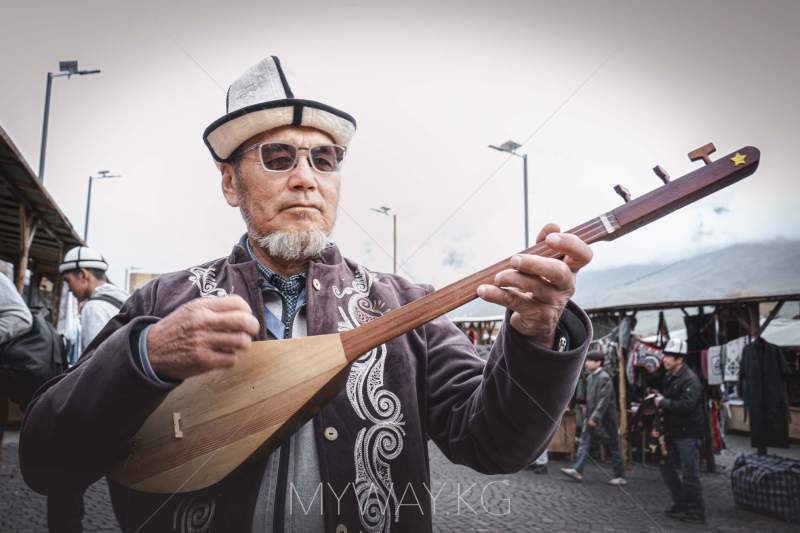
The komuz is one of the most recognizable symbols of Kyrgyz culture. Its crisp, resonant sound evokes the clatter of hooves along a mountain trail, the murmur of rushing water, or a rapid conversation where every note answers the one before it. Yet behind the apparent simplicity of this three-stringed instrument lies an entire world: the history of a nomadic people, the art of musical storytelling, ancestral legends, and craftsmanship passed down from master to apprentice.
For the Kyrgyz, the komuz is far more than a musical instrument. It has long accompanied songs, celebrations, and gatherings, helped tell stories without words, and fostered a warm sense of family unity. Today, it can be heard both in quiet rural villages (aiyls) and on major concert stages, where traditional melodies find fresh resonance.
The komuz is a plucked string instrument featuring a pear-shaped body, a long neck, and three strings. Unlike many modern stringed instruments, a traditional komuz has no frets dividing the fingerboard into fixed pitch positions. This allows the player to shift pitch fluidly and craft signature melodic embellishments.
A traditional instrument is carved primarily from a single solid piece of wood. Its length typically measures around 75–90 centimeters, though exact dimensions depend on the maker and the individual piece. Artisans use several wood species—most notably apricot, walnut, and juniper—with special value placed on well-seasoned timber possessing rich acoustic qualities.
Each primary component of the komuz carries its own name:
Historically, strings were crafted from dried animal intestines, meticulously cleaned and twisted. Today, synthetic materials such as fishing line are also widely used. String material directly shapes the timbre, volume, and character of the sound.
Having only three strings is not a limitation, but a defining strength of the instrument. Their interplay lets the musician carry a melody, build rhythmic drive, and achieve a full, layered sound that often feels far larger than one would expect from a compact wooden body.
The story of the komuz's origin lives not only in historical research, but in folk legends. One of the best-known tales tells of a hunter named Kambar, who became the very first komuzchu—a komuz player.
Returning home from a hunt one day, Kambar heard an unusual, melodic sound drifting through the trees. Listening closely, he discovered a dried piece of mountain animal gut stretched taut between two branches, humming as the wind blew across it. Inspired, the hunter took a piece of wood, stretched a string across it, and fashioned the first musical instrument. According to legend, this is how the komuz was born, and its very first melody was named Kambarkan in honor of its creator.
While not a literal historical record, the legend reveals how folk imagination ties the birth of music directly to nature,keen human observation, and the creative instinct to turn sounds of the wilderness into art.
The traditional Kyrgyz komuz stands out for its single-piece wooden construction: its primary sections are carved from one solid block of timber, though specific shapes and techniques vary across regional crafting schools.
Most often shaped from apricot or walnut wood, it combines a rounded body, a slender fretless neck, and three strings.There are no intricate mechanical parts—only seasoned wood, the artisan's hands, and the musician's skill in turning three strings into a universe of sound.
Behind every instrument stands a master maker. Artisans hand-select timber, carve its contours, hollow the body, and fine-tune the wood to achieve a clear, unmistakable voice. This craft demands not just tools and experience, but intuition passed from teacher to student. Rooted in antiquity, komuz-making remains alive today as contemporary luthiers preserve time-honored methods alongside their own trade secrets.
The foundational genre of traditional instrumental komuz music is the küü—a standalone composition in which melody becomes a wordless narrative. A küü can convey human emotion, mimic the gait of animals, or evoke natural phenomena,historical events, and folk tales.
Unlike a song, a küü needs no lyrics to tell its story. Meaning unfolds through melody, rhythm, repetition, dynamic contrast, and expressive phrasing. Listeners mentally piece together the narrative by following the musical imagery, as sound becomes a language capable of expressing feelings beyond words.
The komuz repertoire preserves works linked to legendary performers alongside ancient melodies handed down across generations. Among the most celebrated forms and titles are Kambarkan, Botoi, Mash Botoi, Kerbez, and Shynggyrama.Because these names can denote distinct musical styles, individual compositions, or regional performance traditions, they represent a rich tapestry rather than a rigid classification.
A special place belongs to Mash Botoi, a küü associated with the renowned komuzchu Atai Ogonbaev. It is widely celebrated as a showcase of expressive technique, blending memorable melody with infectious rhythmic energy, shifting accents, and dazzling fingerwork.
Listening to a küü, one quickly notices how dramatically the komuz changes voice in a single musician's hands: soft and lyrical one moment, sharp, rapid, and almost percussive the next. This expressive range made it a cornerstone of both solo and ensemble Kyrgyz music.
A musician who plays the komuz is called a komuzchu. In traditional culture, a true komuzchu is far more than someone who reproduces memorized tunes; they must grasp the emotional core of a piece, master dozens of right- and left-hand techniques, and move their audience.
Traditional playing incorporates plucking, strumming, rapid right-hand flicks, and agile left-hand fingerings. Players produce crisp, ringing notes, cascading rhythmic runs, and sudden shifts in tone mid-piece.
Virtuoso performers sometimes flip the instrument behind their backs, spin it, or play in acrobatic postures—demonstrating both technical command and the theatrical spirit of Kyrgyz performance art. Still, showmanship is only one facet of stage virtuosity rather than a requirement of traditional playing.
Historically, gatherings of musicians, melody exchanges, and friendly skill competitions formed a vital pillar of musical life. In these encounters, a komuzchu had to prove not merely finger speed, but expressive depth, originality, and emotional persuasion.
For centuries, komuz artistry evolved primarily through oral tradition. Knowledge was shared not through textbooks, but through direct observation: an apprentice listened closely to a mentor, mirrored hand movements, memorized melodies by ear, and gradually cultivated a personal voice.
This mentorship system is known as ustat–shakirt—the bond between master and disciple. An ustat taught far more than physical technique, passing along repertoire, stylistic nuances, and respect for cultural heritage. Becoming a shakirtdemanded patience, dedication, and daily practice, and prominent komuzchu often gathered circles of students that grew into distinct performance schools.
Today, the komuz is taught in music schools and conservatories across Kyrgyzstan, where oral traditions coexist with sheet music, academic training, and modern pedagogy. Cultural researchers emphasize preserving not only the compositions themselves, but also the hands-on ustat–shakirt transmission of nuanced playing techniques.
Although closely tied to solo performance, the komuz now plays an essential role in ensemble and orchestral music as well.
In the 20th century, luthiers developed an entire orchestral family of komuz instruments varying in size, register, and musical role—including the komuz-prima, komuz-sekunda, komuz-alt, and komuz-bass. This innovation allowed the distinct timbre of the traditional instrument to blend seamlessly within large symphonic folk ensembles.
Today, the komuz is heard at national festivals, state celebrations, cultural showcases, and contemporary fusion projects where ancient folk motifs meet modern genres. At the same time, it has never lost its place in daily life—picked up at home, among friends, or around holiday tables to share a familiar küü, accompany a song, or simply capture a mood.
Preserving the komuz involves more than crafting instruments and teaching scales—it means sustaining a living culture in which music links generations, safeguards collective memory, and offers fresh ways to reflect on the past.
It relies equally on luthiers who can read raw timber and unlock an instrument's future voice, musicians keeping centuries-old küü alive, and teachers passing down both fingerings and cultural soul. Thanks to their dedication, the komuz remains an active, vibrant part of modern Kyrgyzstan.
For travelers, encountering the komuz might begin at a concert, a summer festival, or an impromptu gathering in a village home. Its true character shines brightest in live performance—when a musician lifts the carved wooden body, three strings begin to ring, and a story comes alive right before your eyes.
The komuz is a modest instrument with a commanding voice. Within its three strings lives the musical memory of Kyrgyzstan—stretching from ancient legends of the first makers to new generations of artists giving timeless traditions a fresh voice.
Discover more handpicked adventures and guided experiences in Kyrgyzstan