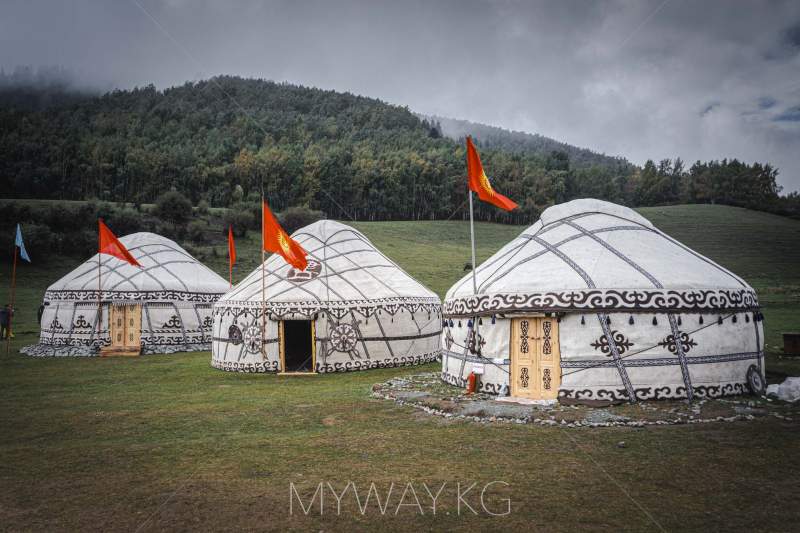
For centuries, the boz üi remained the primary portable dwelling of the Kyrgyz people. Its design answered the demands of nomadic pastoralism: a family could move alongside its herds, migrating from winter camps (kyshtoo) to spring and summer pastures (jailoo) and back again. At the same time, the dwelling had to be quick to assemble, dismantle, and transport.
The name boz üi literally means "gray house"—after the color of its traditional felt covering. The space inside a boz üi is never arranged by chance: it reflects Kyrgyz ideas about the universe, nature, family, time, and humanity's place in the surrounding world. The tündük opens a direct connection to the sky, the hearth gathers family life around itself, the place of honor (tör) is reserved for guests and elders, and the threshold separates domestic space from the outside world.
Creating a boz üi unites almost every facet of traditional Kyrgyz craftsmanship. The carpenter shapes wood into a flexible frame, while female artisans felt wool, weave and braid sturdy bands, embroider patterns, and assemble intricate interior furnishings. Wood, wool, leather, chiy reeds, threads, and metal find new life here, coming together in a single harmonious structure. Even the smallest details serve a unified design: they protect, decorate, mark boundaries, and fill the home with meaning.
The boz üi can be called a living encyclopedia of Kyrgyz culture—written not on paper, but in physical space built by human hands. It combines architecture and craft, practical engineering and artistic imagination, family customs and spiritual beliefs. It teaches people to see the world as an interconnected whole, where humans are not separated from nature, home is inseparable from family, and daily labor is bound to beauty and purpose. Stepping inside a boz üi feels like crossing the threshold not merely of a dwelling, but of an entire universe where the spirit of the Kyrgyz people has taken shape and continues to live.
In 2014, the traditional knowledge and skills involved in making Kyrgyz and Kazakh yurts were inscribed on the UNESCO Representative List of the Intangible Cultural Heritage of Humanity—recognizing that a yurt is far more than an architectural form, but a complete system of knowledge spanning materials, engineering, craft, and cultural traditions.
How a Yurt Is Built: From Foundation to the Sky Circle
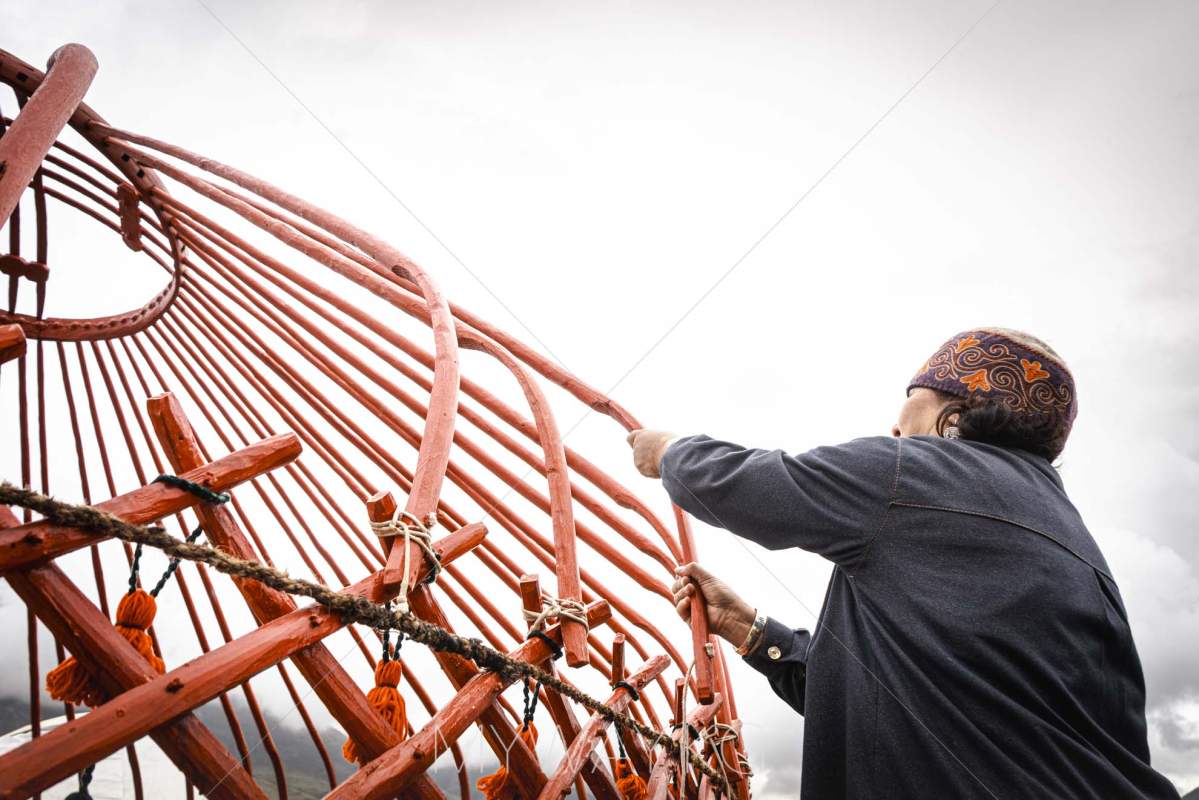
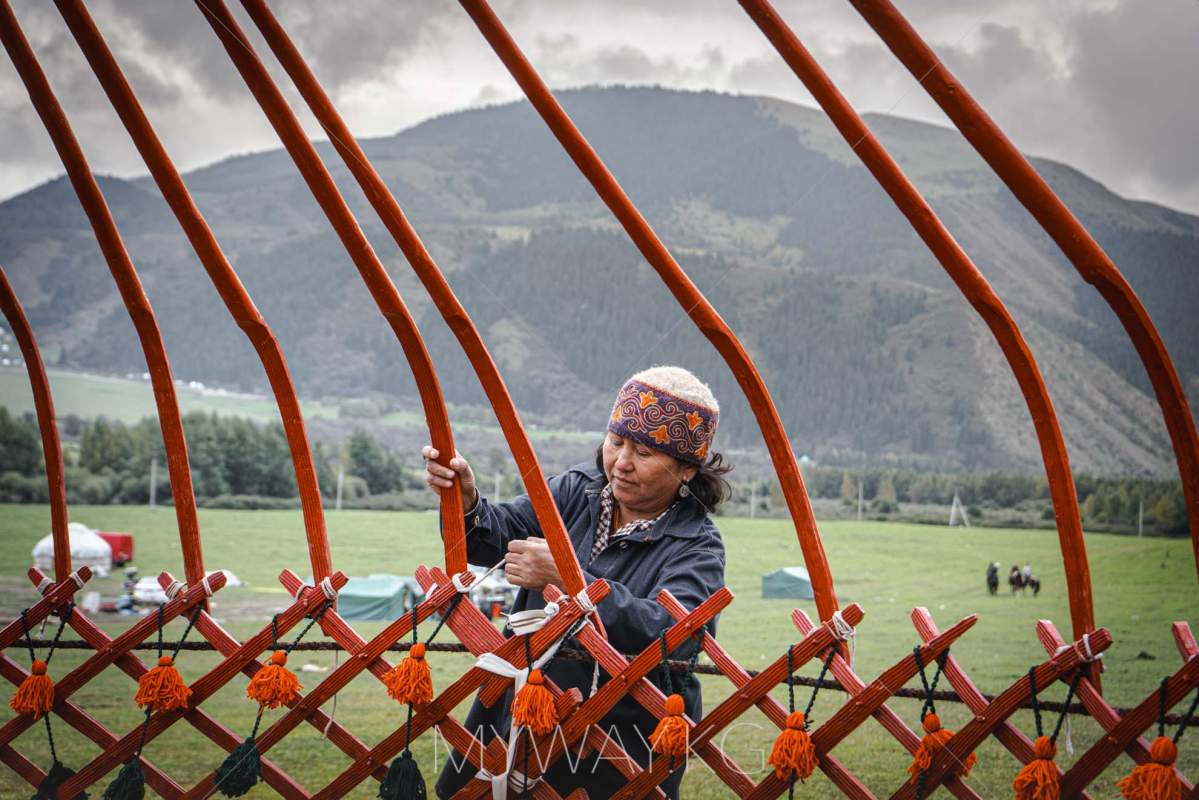
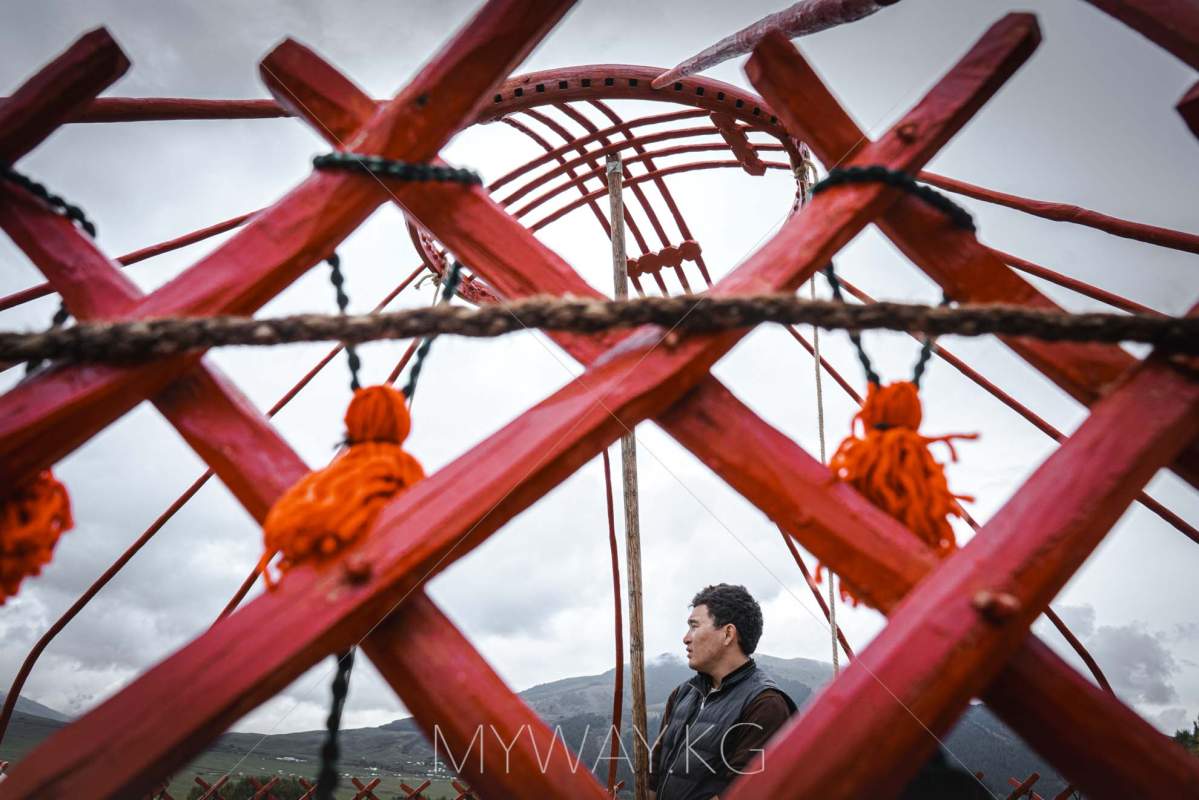
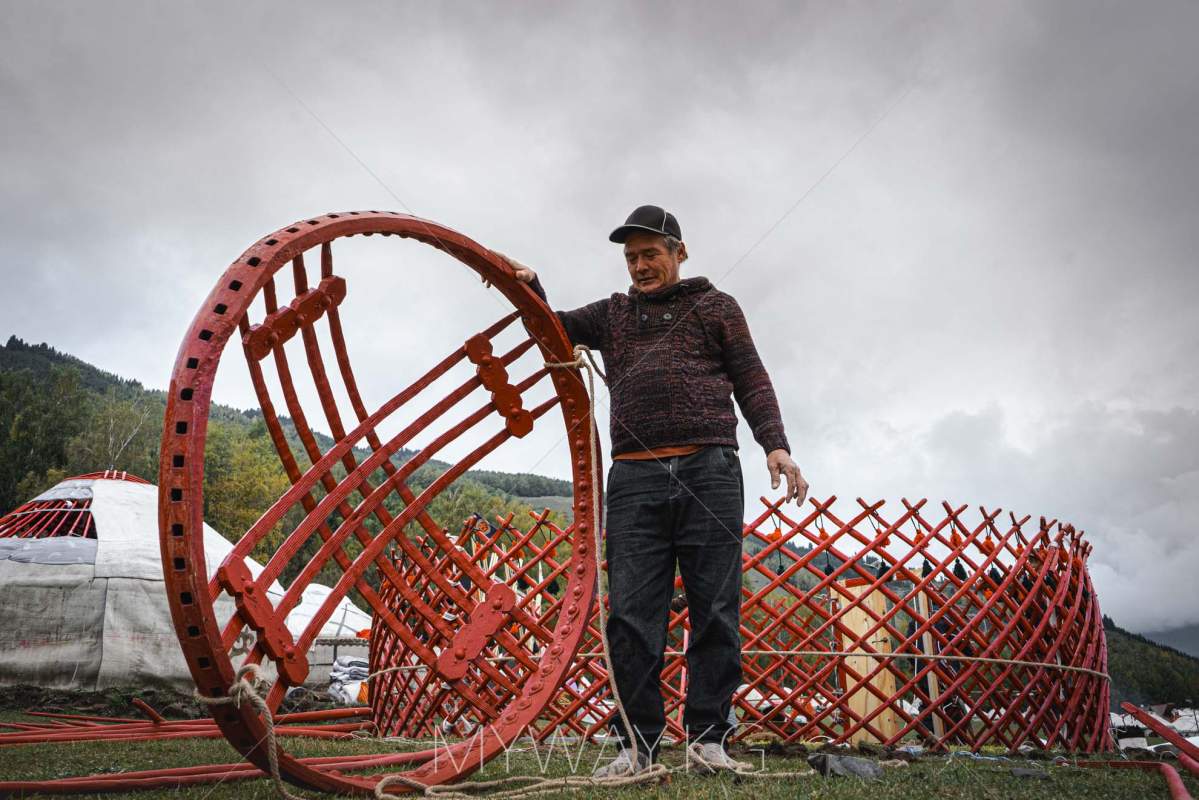
The foundation of the yurt is its wooden frame—the söök, literally the "skeleton." It was built by master woodworkers who needed not only skill with tools, but a deep grasp of the future dwelling's proportions. Major components were crafted from suitable wood species, including willow and birch, each requiring specific dimensions, bends, and joinery techniques.
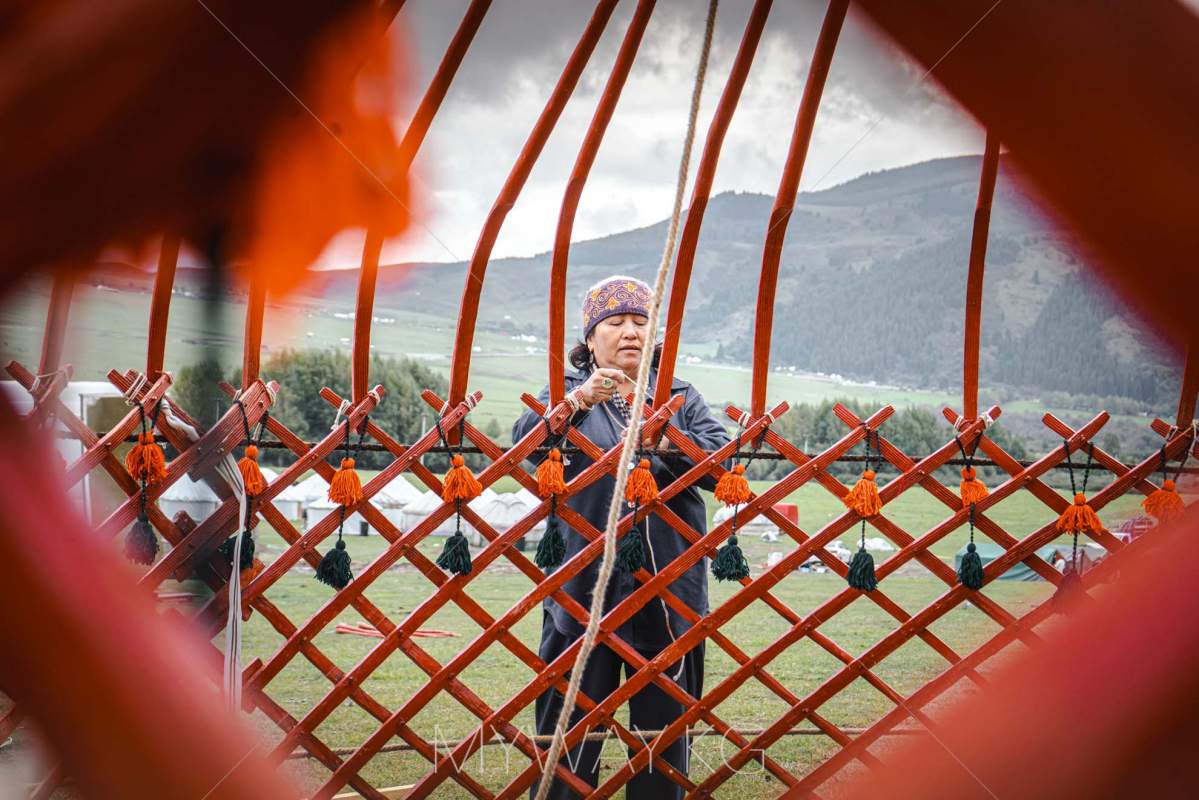
- Kerege — Expanding Lattice Walls: The lower and largest section of the wooden frame. The kerege consists of intersecting wooden laths pinned together so the structure can fold and expand like an accordion. Individual sections are called kanat—a "wing" or segment of the kerege. When expanded, these sections form a circular wall,joined together and secured at the top with special ties. Thanks to this modular design, a yurt can be quickly enlarged or reduced by adding or removing several wings.
- Sakanak — Short Connecting Uprights: These vertical elements help form and link the lattice sections. When pitching the yurt, their alignment is carefully checked so the walls form a true circle without tilting.
- Uuk — Roof Poles: Long wooden poles that connect the lattice walls to the crown ring of the yurt. The lower end of each uuk ties onto the upper forks of the kerege, while the upper tip slots into holes along the tündük. Together,they shape the dome—the unmistakable silhouette of the Kyrgyz yurt. The curve and length of the uuk determine the height and profile of the roof, and their number depends on the size of the dwelling.
- Tündük — The Crown Ring: One of the most recognizable features of the boz üi—a circular wooden hoop reinforced with crossed curved ribs. The upper ends of the uuk lock into its perimeter, while the open center vents smoke and lets in daylight. The tündük acts as both window and chimney at once, and is also known as changarak—the "door to the sky." More than a structural keystone, the tündük is a powerful symbol of the family hearth and lineage continuity. Its emblem stands at the center of the state flag of Kyrgyzstan, with sunbeams radiating outward as a reminder of the home that unites people.
- Bosogo Tayak — Doorframe: Vertical and horizontal wooden timbers—an upper lintel, side jambs, and a lower threshold—form a sturdy rectangular frame to which the door is mounted.
- Kaalga — Wooden Door: Unlike a lightweight felt curtain, the kaalga is a genuine double-leaf wooden door, often adorned with carvings and traditional ornaments. In a traditional dwelling, it secured the entrance and completed the structural ring of the yurt.
Felt Clothing: Protecting the Yurt from Cold and Wind
Once the wooden skeleton stood ready, it was dressed in sheep's wool felt (kiyiz). This required separate panels, each with its own name and exact placement:
- Tuurduk — Wall Felts: Large panels covering the kerege walls and the lower section of the dome. A medium-sized yurt typically required three tuurduk, while larger yurts needed four or five, fitted with overlapping edges to leave no gaps against drafts.
- Üzük — Dome Coverings: While tuurduk covered the walls and lower roof, üzük protected the upper dome.Usually two large trapezoidal sheets were used: the front (aldyngky üzük) and the rear (törkü üzük), draped over the roof poles, overlapping the tuurduk, and meeting near the crown ring.
- Tündük Jabuu — Crown Ring Cover: A square felt flap used to close the top opening of the yurt. Using attached corner ropes, it could be pulled aside, lifted, or drawn shut from the ground to regulate indoor light, ventilation, and hearth smoke.
- Jëëk — Woolen Edging Cord: The edges of felt panels were stitched with thick braided wool cording to reinforce the felt, prevent wear, and help each panel hold its shape.
- Kiyiz Eshik — Felt Door Flap: An additional felt covering hung over the entrance to block cold air and dust, often combining thick felt with a woven chiy reed mat.
Chiy: The Woven Mat Between Wood and Felt
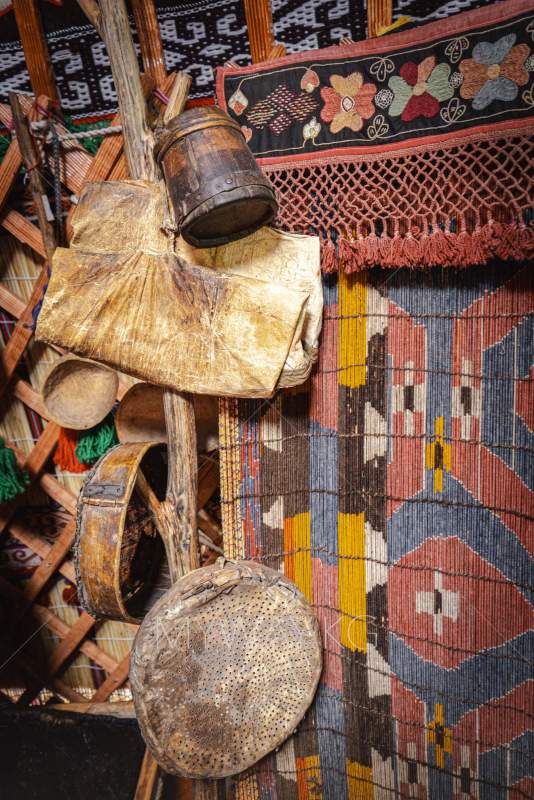
A traditional yurt is impossible to picture without chiy—a tall steppe grass with tough, straight stalks. Lightweight mats woven from chiy were wrapped around the outside of the lattice walls directly beneath the felt covering.
Chiy performed several jobs at once: shielding the interior from wind and cold, retaining warmth in winter, and allowing fresh air to circulate in summer when the lower edges of the tuurduk wall felts were rolled up.
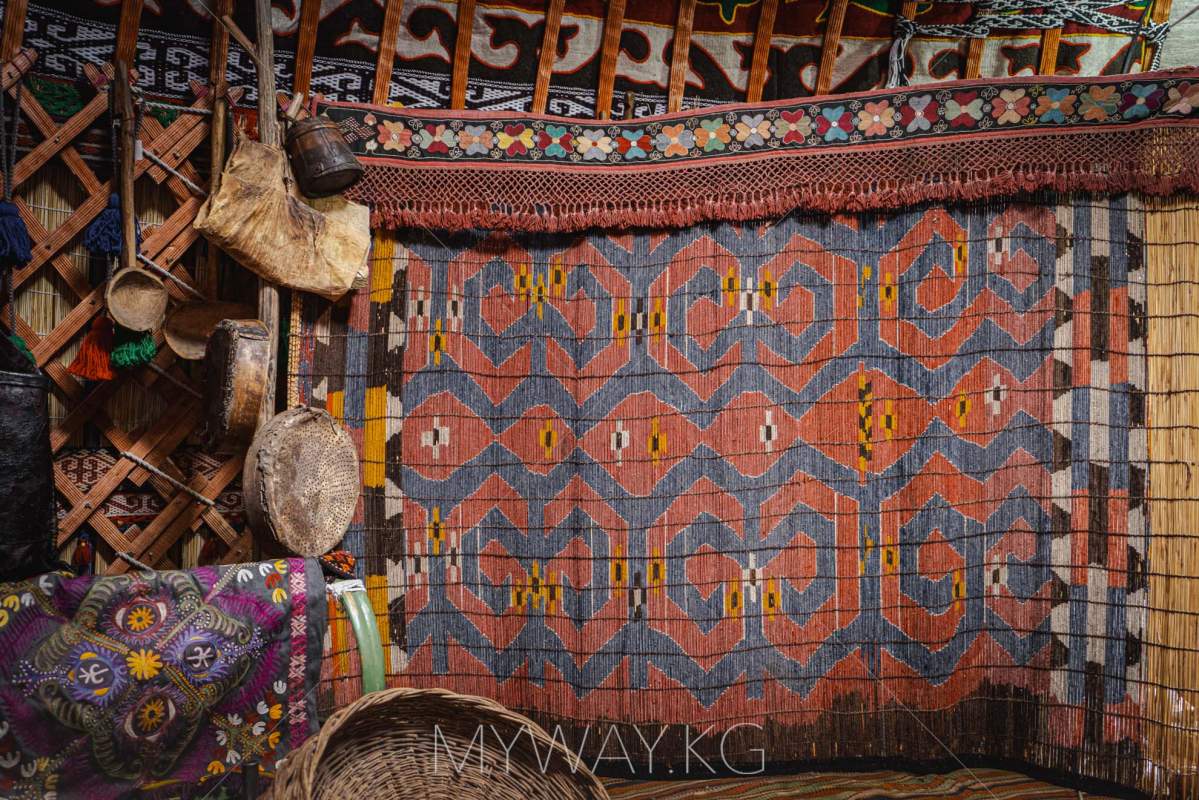
Beyond utility, chiy weaving evolved into a distinct decorative art. Individual stalks were wrapped in dyed wool threads to form geometric patterns, creating ornamental screens:
- Kanat Chiy: Patterned reed matting wrapped around the outer walls of the yurt.
- Eshik Chiy: Decorative matting crafted to frame and protect the entrance.
- Chygdan Chiy: Patterned reed partitions used to screen off the kitchen and food storage zone.
Ribbons and Fastenings: Every Detail Has Its Name
The fittings of a Kyrgyz yurt incorporate an intricate system of woven, braided, and embroidered bands, cords, and tapes.Every piece serves a dual purpose: locking the wooden frame tightly together (structural function) while protecting the home from misfortune and showcasing the artisan's skill (decorative and symbolic function).
All cords and bands in Kyrgyz are collectively known as boo.
Crafting them required specialized mastery. Bands were woven from wool and other fibers in colors harmonized with the interior. Interior bands were woven using terme—an intricate warp-faced pattern-weaving technique on the traditional horizontal örmök loom (from terip soguu, meaning to pick and pair threads with a wooden stick, tergich, to build geometric motifs)—alongside kajary (bukary), besh keshte, and syzma techniques.
Traditional motifs were chosen with care, led by kochkor müyüz ("ram's horns"), one of the most iconic symbols of Kyrgyz decorative art, alongside müyüz (horn), jolbors tyrmak (tiger claws), kekilik kash (partridge eyebrows), it taman(dog's paw), toguz döbö (nine mounds), tegerek köchöt (circle motif), badam (almond), karga tyrmak (crow's claws),kyyal (fantasy), kabyrga (rib), and iyrek (zigzag).
Interior Decorative Bands and Tassels
- Tegirich: A wide patterned woven band encircling the upper walls, helping reinforce and frame the interior. Its exact height varied by regional tradition depending on the curve of the roof poles.
- Kerege Tangych: A woven band used to tighten and stabilize the kerege lattice; in the Alay Valley, it was wrapped around the upper wall perimeter.
- Bash Chalgych: Patterned webbing linking the tops of individual kerege sections.
- Kapshyt Tangych: Cords securing the short side uprights (sakanak) next to the doorframe.
- Uuk Tizgich: A long, narrow woven tape threaded across the roof poles to hold their spacing steady.
- Chachyk: Lush decorative tassels (typically bright red, burgundy, or blue) suspended where the poles meet the crown ring and at the ends of securing bands, swaying gently in the breeze.
Exterior Tie Ropes and Girth Bands
- Tuurduk Boo: Ties fastening the wall felt panels to the frame.
- Üzük Boo: Straps securing the upper dome felts.
- Jel Boo (or Tündük Boo): Storm ropes anchored to the tündük to steady and adjust the crown ring.
- Jan Boo: Cords sewn to the corners of the tündük jabuu cover, tying it down to the yurt's outer belt.
- Kyrchoo: The heavy outer girth band wrapped around the exterior to hold the felt layers tight and brace the entire structure against wind.
- Sakanak Tangych & Kerege Chalgych: Bindings used to connect and lock the lattice wall components.
Not all of these elements were purely ornamental: some primarily ensured structural rigidity, while others combined load-bearing strength with visual beauty. Their names and placement often varied across regions.
Interior Space: Every Side Has Its Purpose
Nothing inside a boz üi was placed at random. Interior space was organized by function, age, family status, and traditional concepts of domestic order:
- Tör — The Place of Honor: Positioned directly opposite the entrance, beyond the central hearth. This is the most respected area of the yurt, reserved for elders and honored guests. Stacked neatly along the wall here is the jük—folded bedding, quilted blankets (töshök), pillows, carpets, and felts arranged atop wooden chests or stands, draped in fine fabrics and embroidery. In some homes, a komuz and cherished family heirlooms were placed nearby.Historically, the height and neatness of the jük reflected both the household's prosperity and the skill of its women.Seating guests in the tör expressed genuine respect for their presence and standing.
- Er Jak — The Men's Side: The left half of the yurt when looking in from the entrance. This side held men's clothing, hunting gear, weapons, horse tack, saddles, bridles, and tools used in male household duties. In some traditions, this area also housed newlyweds, while the section closest to the door (kulaga) held riding gear and utility items.
- Epchi Jak — The Women's Side: The right half of the yurt from the entrance, housing dishes, provisions,cookware, and everything needed for preparing meals and managing the household. This zone was typically screened off with a chygdan reed mat. Here stood the ala bakan—a branched wooden pole for hanging clothes and bags—alongside woven or stitched holders like ayak kap and chyny kap for bowls and utensils.
- Ulaga — The Entrance Zone: The space directly inside the doorway, serving as the transition between the outside world and the home interior, where footwear and everyday utility items were kept.
- Kolomto — The Hearth: At the center of the yurt burned the open hearth—used for cooking, boiling water, and heating the dwelling. As the heart of the home where the family gathered, its position aligned directly beneath the open tündük so smoke could rise cleanly. The hearth was treated with deep care and respect: clutter was never placed near it, and the fire was tended attentively.
Decoration: Felt, Fabric, Ornament, and Household Items
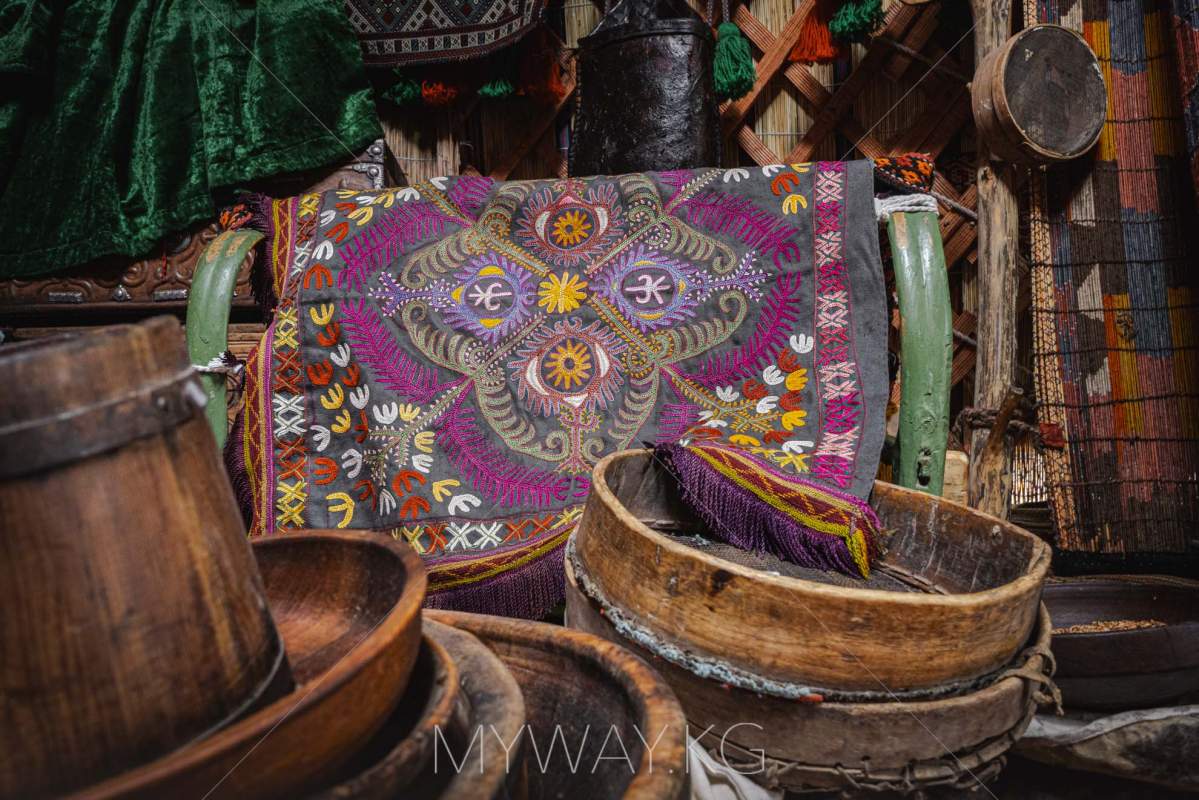
Warmth and comfort inside a boz üi came not only from thick outer felts, but from rich textile furnishings—carpets,embroidered wall hangings, woven bands, reed mats, and crafted storage bags:
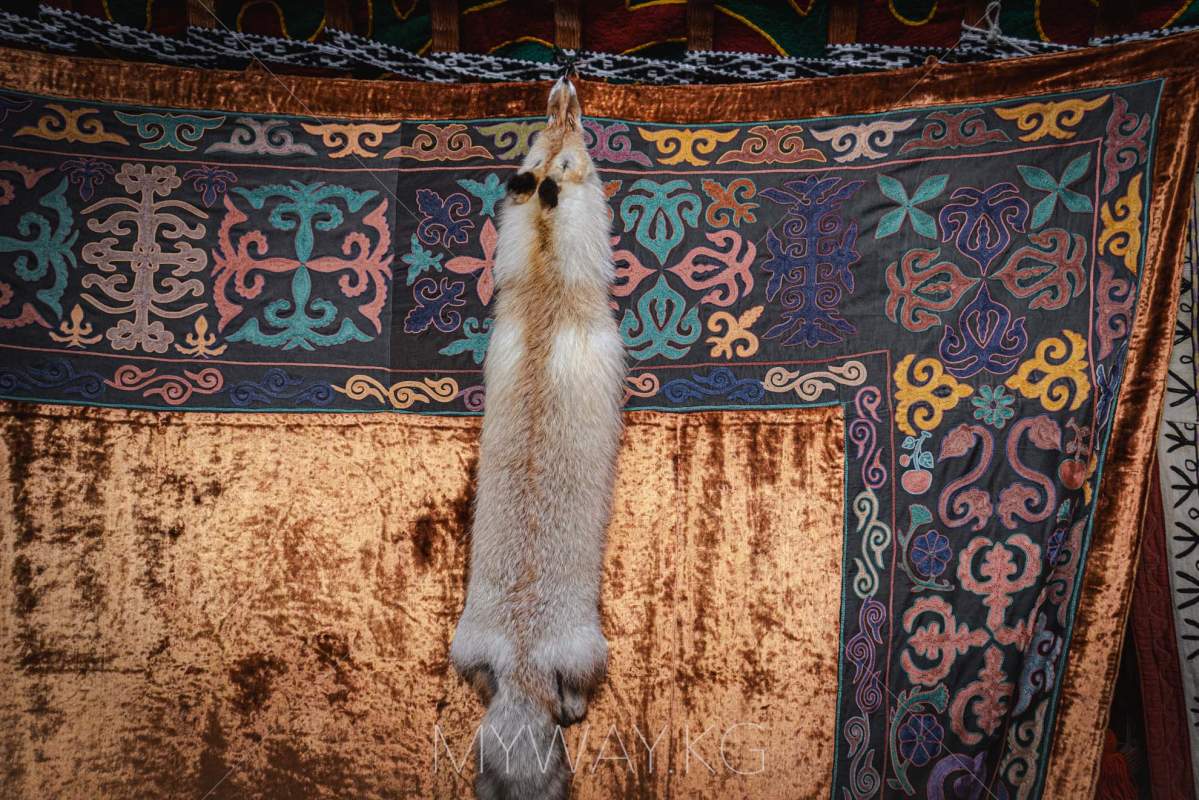
- Tush Kiyiz: An intricately embroidered wall hanging placed in the honored tör section behind or above the jük,showcasing the needlework of the hostess and often forming part of a bride's dowry.
- Shyrdak: A mosaic felt rug crafted from contrasting layers of colored wool felt cut and stitched together in crisp interlocking patterns, laid across the floor for warmth and beauty.
- Ala Kiyiz: A felted wool rug whose patterns are pressed directly into the fibers during the wet-felting process,creating softer, organic motifs that appear blended into the felt itself.
Tableware and Everyday Objects
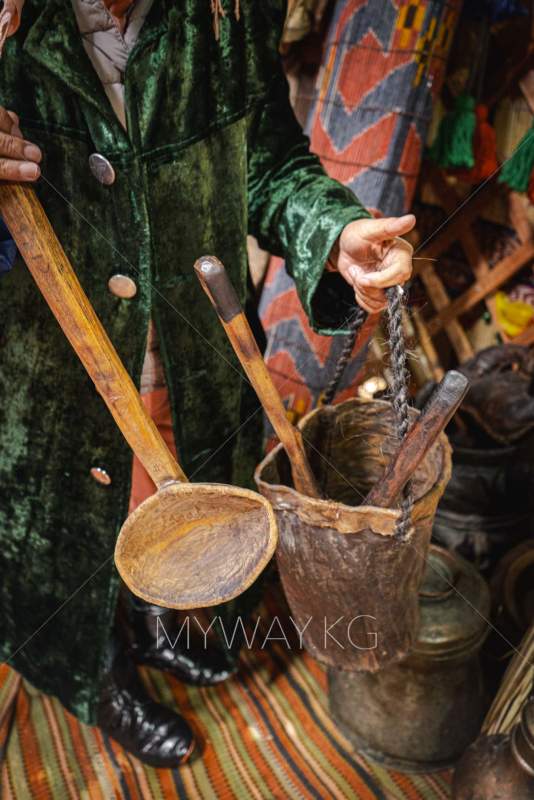
On the women's side, households stored cookware and provisions made from durable, travel-friendly materials—wood,cured leather, felt, woven wool, and metal.
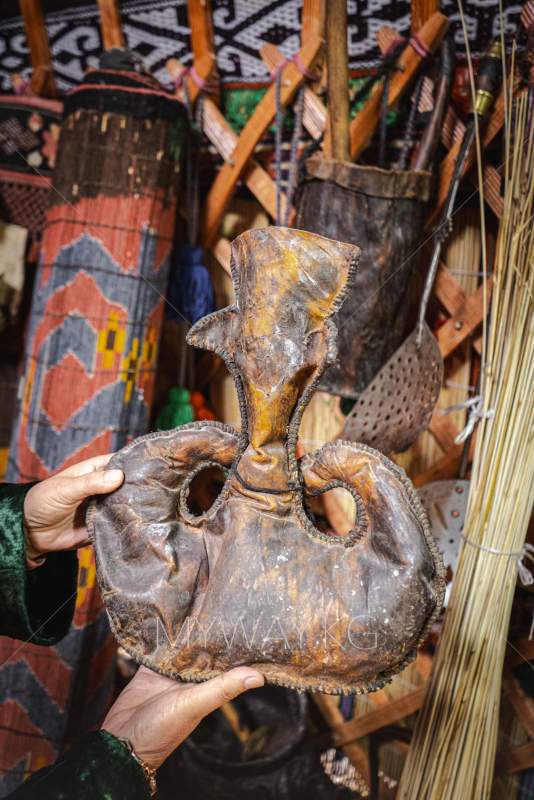
- Saba: A large sewn leather vessel used for churning, fermenting, and serving kymyz (fermented mare's milk).
- Könök: A molded leather pitcher for storing and pouring liquids.
- Chanach: A leather skin bag used for storing and transporting dairy products on the move.
- Ayak Kap: A woven or embroidered hanging pouch for wooden bowls and dishes.
- Chyny Kap: A padded protective case for porcelain tea bowls (piala).
- Kese: A drinking bowl or cup for tea and broth.
- Tabak: A broad wooden platter for serving communal dishes.
- Kumgan: A narrow-necked water pitcher used for handwashing and daily hygiene.
- Tulga: A three-legged iron trivet supporting a cauldron over the hearth fire.
- Bokcho: A woven or leather bundle bag used to store personal clothing and belongings.
The Yurt in the Modern World
Today, yurts are still pitched every summer across Kyrgyzstan's jailoo mountain pastures and remain central to family celebrations, weddings, and cultural festivals. For travelers, spending a night inside a boz üi offers a rare chance to experience the unhurried rhythm of mountain life: listening to the wind brush against thick felt walls, watching stars shine through the circular frame of the tündük, and sharing hot tea around a welcoming table.